Developing Historical Thinking in Upper Elementary Students
by JETS co-Director Stan Peerless
Sunday, May 11, 2014

Friday, May 9, 2014
Weird Warfare, the Divine and Stories from Under the Ground: A Virtual Visit to the Middle East
The history, ethnicities, diversities and conflicts of
the Middle East undoubtedly account for some of the most confusing subjects of
world studies. While Americans are bombarded almost daily with news stories
about the events that take place in the region, surveys of the American public
indicate that few Americans actually have even a basic understanding of the
issues that are involved the region's geopolitical conflicts.
For the past 5 years JETS Israel has been working with
public and private schools throughout North America to provide a comprehensive
overview of the Middle East in an interactive elearning environment. In the
spring of 2014, JETS launched an engaging course on the Middle East with the 6th
graders of St. Agnes and St. Dominic in Memphis TN. The Israel-based
instructors meet the class weekly via video-conferencing to present the course
material, answer questions and guide the students to a deeper understanding of the
historical background behind today's Middle East.


One of the most popular sessions, Weird Warfare, takes
the students through the centuries as they examine warfare in the Middle East
in ancient and modern times. The students are challenged to understand how the geographical,
economic, and political realities of the ancient Middle East made Israel a
battleground throughout the ages. They then compare the explosive nature of the
Middle East today, as they consider many of the same issues which occupy the
minds of world leaders: Should the U.S. continue military aid to countries in
the Middle East? Why is Israel pulled in so many directions? How does an
analysis of history affect Middle Eastern nations' military decisions today? In
addition, they look at ancient and modern weaponry, and the military strategies
associated with both.

Each lesson includes a follow-up assignment on the
class Haiku Learning Management System page with engaging activities that push
the students to delve into the subject more deeply.

Through this session of the course, the St. Agnes –
St. Dominic youngsters' have certainly increased their knowledge and
understanding of the Middle East, and are better-informed about the issues that affect
their world.
Jewish Teachers, User-Friendly Tools and Easy Entry into the World of 21st Century Online Learning
"At the beginning it all seemed overwhelming but as we went through each tool, I really felt like I had a virtual toolbox of how to make learning more interesting and engaging for my students...all of the follow up emails with links and the recorded classes gave us the ability to listen whenever we wanted and go back to the links via the haiku…these aids took the pressure off a bit".
When I signed up to take the JETS No Teacher Left Behind online course, I found myself diving into a world that seemed to be light years away from my previous teaching reality. Online bulletin boards? Linos? Google forms? Vokis? Vocaroos? Spreadsheets? Presentations? Who was I kidding? I still lived in the world of chalkboards and textbooks.
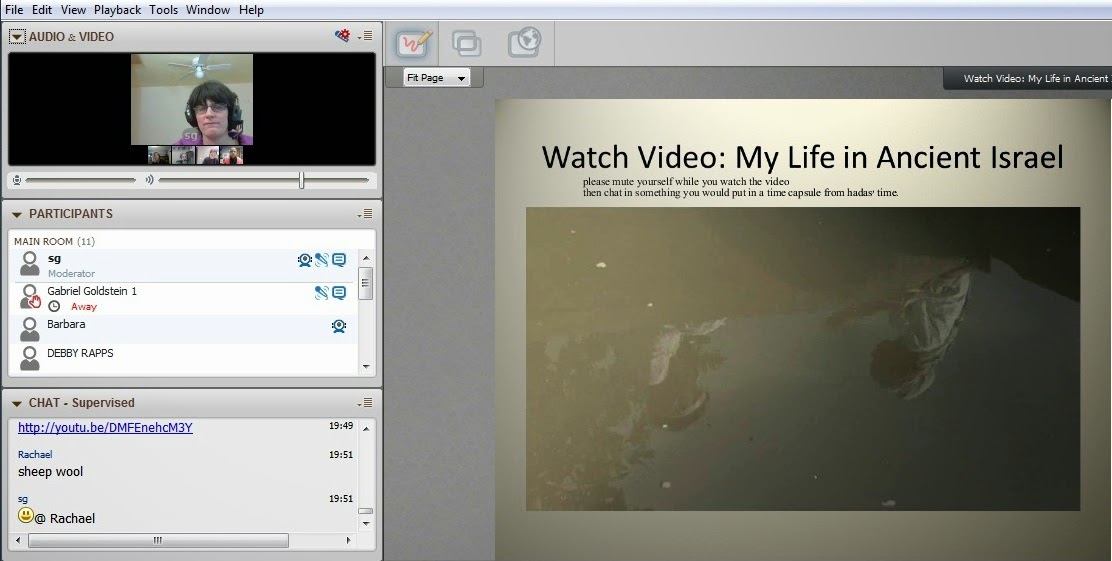
It turns out that chalkboards and textbooks translate very well to
the digital age. All over the world, kids as young as 1st grade are
learning more and stretching their limits with synchronous, blended and
asynchronous learning which can be delivered on a tablet or PC screen.
I was astounded by the No Teacher Left Behind course. I may not
have been the most technologically-advanced student in the virtual classroom,
but I expanded my horizons as I explored the different options that were at my
fingertips which would allow me to present material via new and exciting
techniques to students who lived anywhere in the world.

My NTLB course provided me with a base for using elearning tools
and ideas to engage and challenge my students about almost any subject. Each
year, JETS runs three such courses in which educators from around the world meet
virtually and become acquainted with the new world of distance learning. This
interactive course provides ample opportunity for hands on experience, as each
participant prepares and presents a model lesson which is reviewed by the
instructor and the other students.
The spring 2014 course ended a few weeks ago and educators from
North America, Israel and Europe shared their reflections about the course.

"The instructor was absolutely excellent, what a joy to work
with such an experienced educator. I was also pleasantly surprised by the level
of the participants and loved learning from and with them. And so great to see
all those motivated Jewish educators!"
"As we work with various students (day school, supplementary school, agegroups) it might be an idea to combine participants according to their target group. On the other hand, I loved seeing all these different perspectives."
"As we work with various students (day school, supplementary school, agegroups) it might be an idea to combine participants according to their target group. On the other hand, I loved seeing all these different perspectives."
"The fact is that working with these new educational tools is
not as complicated as I expected. The choices were excellent; most could be
applied directly and it was fun to use them to create teaching material. The
lino board, in particular, was an eye-opener. For me, this is just a beginning
and I am looking forward to learning more, especially about curriculum
development for online teaching."
"I especially liked the fact that it was so interactive. And
the course taught me that I can use so many different kinds of new media in
online learning as well as in classroom learning."
"The course showed me new tools and taught me how to use
them. Some tools I already knew, but I just had no idea I could use them as
teaching tools. The course also motivated me to try those tools and practice
using them."
"I gained a lot of new tools, and more importantly a new way
of looking at learning - how do we learn online differently than we learn
face-to-face? What are the advantages that we can use and what are the
challenges we have to watch out for?"


Tuesday, May 6, 2014
Making the Aliyah Story Real -- Shutafut Partnership
When I was 14, I came across Leon
Uris's book Exodus and my life was changed forever. I identified with the
history, the struggles, and the exhilaration of the people who made their way
to the Land of Israel to build the country and work to create the state. I decided then and there that I would live in Israel.
My aliyah differed significantly from
that of the late 19th century halutzim , even though I was a
founding member of a new kibbutz for a while. We did move some rocks and
bicker over ideology but we had plenty to eat and comfortable living
accommodations. The only thing that I needed from "back home" was
tuna fish and chocolate chips (novelty items in Israel in the mid-'80s).
Aliyah isn't a step that everyone can
take, but it's still a concept that speaks to the imagination and longing of
Jews worldwide. To give youngsters a sense of the magic and feeling of
wonderment that aliyah engenders, JETS uses online tools to help them develop an understanding of why so many individuals are prepared to uproot their lives
in order to be a part of the Jewish country.
Throughout the year, the TALI Shutafut
program has been building towards the highlight of the year – the opportunity
for the Israeli and American students to join together in their celebration of
Yom HaAtzmaut.
After building up to the aliyah unit
with units that examined the ethnic origins of Jews around the world and the
challenges facing Diaspora Jewish communities, the May Tali unit is focusing on an overview of the reasons that Jews
choose to make aliyah, the challenges that they face, and the aliyah stories of
different ethnic groups.

The aliyah unit encourages the
American and Israeli partner-classes to join together to examine some of the reasons
that Jews make aliyah, despite the difficulties. Special emphasis is placed on the impact of Ethiopian Jewish aliyah, both on Israel and on the Ethiopian Jewish olim themselves.
The students are also given the opportunity to consider the concerns that making aliyah raises such as moving to a new land with a new language that is far away from family and friends.

The unit concluded with inspiring personal
aliyah stories that underscore the unique connection that Jews of all
backgrounds, ethnicities, ages and religious affiliations feel for Israel.
Monday, May 5, 2014
Flipping the End-of-Year PD Class -- Students Teach
As the school year draws to a close,
teachers and administrators are considering ways to enrich
student learning in the coming year.
Towards that end, the Maayanot School in
New Jersey invited their teachers to join a Professional Development session
with Smadar Goldstein of JETS - Jerusalem EdTech Solutions about using web
tools in the classroom.
As part of the session, Smadar introduced the
Learning Management System as a technique to facilitate blended and
asynchronous learning in a dynamic environment of independent study.
Using an LMS offers a wide range of clear benefits,
including the ability to promote active learning, foster collaboration,
differentiate instruction, and implement alternative assessment models. Smadar was aware that teachers are often resistant to new technologies and
methodologies. In order to break through resistance she came up with a novel
idea – to have her students participate in the PD session.
The PD session focused on:
·
creating lesson plans that take into account differentiated learning
patterns
·
break the monotony of a classroom session by increasing communication
and collaborative learning
·
monitoring students' participation
·
facilitating the exchange of ideas, concepts and data among students and
between the students and the teacher
·
leveraging technology by creating content that allows for the inclusion
of web tools and social media
·
providing students with flexible access to learning resources which
include resource material, videos, audio casts, text files and more. All of
these resources can then be stored for future referrals and further use.
·
accessing materials at any time.
Students who miss class are not left hanging….they can open the LMS and access
their classwork.
·
engaging in self-paced learning to all each student to learn according
to his or her personal needs
While Smadar was leading the PD session
from Jerusalem, three of her students from Yeshivat Kadima in St. Louis joined
the gathering via the web-conferencing platform. They presented their own
thoughts and impressions about their encounter with their LMS-based course onContemporary Jewish Issues.
Throughout this year the Kadima students
have been exploring today's issues which face the 21st century
Jewish world in light of Jewish history. Their assignments and projects are all
presented and shared via their class's LMS which is facilitated by Ms.
Goldstein on Haiku platform.
The Maayanot teachers took advantage of
the students' presence to ask them numerous questions about how the online
class works, whether they like it, how it differs from a
"traditional" class, and their overall reflections. The teachers were
impressed by the student responses, such as the following:
"I used to think it would make
learning more complicated and that it would make everything take longer (less
productive), but it makes it pretty simple. Everything is a click away and I
don’t have to shlepp home a text book, which means I never have to worry about
accidentally leaving books at home, because everything I need is on my computer
in a cloud." Hadassah
" I love the
way I can do my work whenever, and there are always fun projects both online
and “on paper/physically” that make it fun to learn - almost feels like you’re
not learning. If I want to add more, it’s easy to do with the online platform." Elianna
" I know that this class allows
me creativity and self expression. I learn so much about the history of the
Jews, but more importantly I understand how it relates to me." Bella
The students turned out to be great
teachers, and the teachers were receptive students. After hearing from the
Kadimah students, the Maayanot teachers expressed increased enthusiasm about the use of
online tools in their classrooms.
Read More of the
Kadima students reflections
Beyond the Yom HaAtzmaut Parade – An Interdependent Israel Independence Day Adventure
Yom HaAtzmaut – Independence Day -- celebrates one of
the most miraculous occurrences of all times – the return of the Jewish people
to the Land of Israel and the establishment of the State of Israel.
Israeli kids feel the excitement of Yom HaAtzmaut as they
are thrown into the spirit of the holiday together with their countrymen. They
may, however, lose sight of the meaning behind the celebrations. Meanwhile Jewish kids
who live outside of Israel celebrate Yom HaAtzmaut vicariously and don't
experience the thrill and exhilaration that Israelis feel.
To bridge these gaps the JETS Edmonton-Emek HaHula Shutafut
program focusing on Israel and Jewish Peoplehood encourages
participating classes to work together to dig deeply into the theme of Yom
HaAtzmaut as they take a closer look at issues of Jewish peoplehood.
The Shutafut project, which is facilitated by JETS Jerusalem
EdTech Solutions, bases its curriculum on the following definition of Jewish
Peoplehood:
Jewish Peoplehood is a
combination of culture, religion, history and values under a Jewish umbrella
that gives us the profound feeling of being connected to other Jews. It is a
sense of responsibility created by people who share a story, or are part of the
same ongoing conversation. It is maintained through ongoing education and
contacts between Jewish people.
As Yom HaAtzmaut approaches JETS posted the final unit of the year, exploring
issues that unite the Jewish people and unify Jews worldwide with Israel. The
unit involves a wide variety of opportunities for students to think deeply
about the place that Israel holds for all Jews.. Toward that end participating students
were asked to complete a thought-provoking survey that points to the fact that the creation of the Jewish state has raised complex challenges. The survey forces the
students to share their thoughts about issues of mutual responsibility of
Diaspora Jews for Israel, and Israeli Jews for the Diaspora. For example:
·
Should the Israeli army protect Jews around the world?
·
Should Diaspora Jews serve in the Israeli army?
·
Should Diaspora Jews vote in Israeli elections or have
a say in Israeli policies?
·
Should Diaspora Jews pay a tax to Israel?
As part of this unit students also
view the Fountainheads Yom HaAtzmaut video:
The video is
intended to spur a discussion about the lyrics –
" This is my homeland / This is my
story / I build my future/ With ancient glory." Questions include:
§ How
do you understand that line?
§ b.
What is another line in the song that echoed the meaning, or which line did you
find meaningful?
Students communicate
with each other on the bi-lingual Wiki platform which facilitates the ability of students to
respond in their own language or to practice their second language skills by
writing in Hebrew or English.

As a recent online meeting demonstrated, the students gain a
tremendous amount by interacting on the WIKI, exchanging ideas and learning
from each other. Although the Edmonton and Emek HaHula students won't be
celebrating Yom HaAtzmaut together "face-to-face" they will, via
their Shutafut program, be learning and
celebrating together through the online friendship that has been fostered by
their year-long partnership.
Sunday, May 4, 2014
Do You Celebrate the Christmas? - No, we're Jewish!
Do You
Celebrate the Christmas? - No, we're Jewish!
For students of Hochberg
Preparatory Jewish Day School in Miami and the Mabbuim elementary school of
Southern Israel, the highlight of their year-long "Friends Across the Sea"
school partnership program came last week when the kids were able to
"meet" each other via live video chat.
Throughout this past
school year, the 5th and 6th grade students have been
working on shared projects which are facilitated on the MyHaiku Learning
Management System. Each month the
classes would explore new subjects that were posted in English and in Hebrew on
their shared LMS platform. The curriculum included a wide range of subjects such
as Jewish diversity, seeing the world through a Jewish lens, and information
about similarities and differences between worldwide Jewish communities. The
students were also encouraged to personalize the subject matter as they
discussed their own families and their views of Judaism and Israel.

Although the communication through the LMS was active and engaging, the students in both classes frequently voiced their desire to develop a more personal relationship with their "friends across the sea." JETS therefore set up a virtual meeting via web conferencing software. The students could see each other and connect by chatting, both by SKYPEing on the big screen and using a back channel to type to each other on Today's Meet. In addition to the opportunity to actually meet each other, the format allowed the students to practice their language skills and learn more about their peers' lives.


A significant amount of the chat centered around the students' shared interest in sports, but other subjects included the weather, families, holiday celebrations and school. The students were enthusiastic about their meeting and have already asked for a second video chat opportunity.


Anat, a teacher at Hochberg Prep, was pleased with the chat results. She wrote:
"I thought it went very well! Students on both sides were asking each other questions and gave answers and sang songs to each other (ours - sang in Hebrew 'Mi Shema'amin Lo Mefached" and theirs - sang in English 'We are the World'). The atmosphere was very friendly and fun! They asked about what we do during Shavuot, our daily schedule, what sport we like, etc. Our students asked someone if they had a Bar Mitzvah, and what they do in the summer and for Lag Baomer... They really enjoyed comparing notes and cheering for each other! It was really fun to watch! Thanks for making this happen! I really felt that it brought the students closer together! Y'shar Koach!!!"

Subscribe to:
Posts (Atom)